Six Signs a Scary Cryptid Is in Your Neighborhood
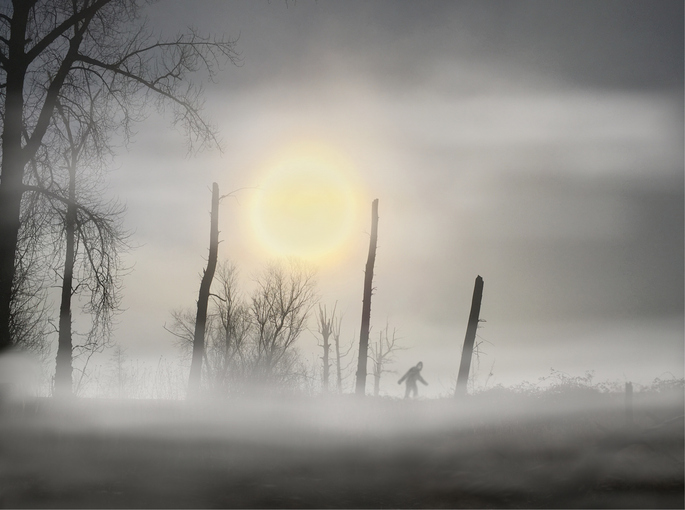
By definition, paranormal cryptids (as opposed to the type of creature once thought a myth that's been proven to exist, such as the komodo dragon or gorilla) are elusive, including the more dangerous ones. We might not actually see them, but rather get indications of their presence by a variety of signs and phenomena. Here is a short list of phenomena that might indicate the presence of a cryptid in your neighborhood. Any of these phenomena could be taking place without paranormal origin, but the scarier cryptids seem to be more aggressive about presenting signs of their presence—they're not scared of us! If a number of these phenomena are happening frequently it might indicate that something very strange is going on.
1. Weird Noises
Do you often hear strange noises, particularly at night? This will depend, of course, somewhat on where you live. It's always fun to familiarize yourself with the night sounds of the outdoors in your area. It's fairly easy to distinguish the calls of owls (like the screech owl call with a little trill at the end) or the barking of dogs, or the "yipyipyip" calls of coyotes, but if you're hearing sounds you don't normally hear at night, this can possibly indicate the presence of a cryptid.
All felines make yowling cries, or sometimes cries that sound almost human and may resemble a child crying, when in the mood for fighting or mating, and the phantom panthers are no exception. If you hear such a very loud cry when there shouldn't be a cat of panther- or bobcat-size in the area, it might be the cry of a cryptid.
More people have probably searched for bigfoots in North American than have looked for any other type of cryptid, so more information has been gathered about their habits. Bigfoots have been said to make some very odd sounds, and there is a great deal of online audio material devoted to possible bigfoot sounds. Much of this are sounds like growling and grunting, and sometimes sounds that resemble a monkey chattering. Black bears use a variety of grunting sounds in communication, and it's quite possible that some bear sounds are mistaken for bigfoot sounds. Black bears, however, tend to be more active during the day, especially, like many animals, at dawn and dusk, whereas if you hear such sounds at night they might be more likely to be bigfoots, which are more nocturnal creatures.
On a different note, a bigfoot is also said to be capable of making birdlike sounds—for example, a sound resembling the call of a whippoorwill or the hoot of an owl, but just slightly different from the sounds of the birds in question. Bigfoots have also been said to signal each other by beating on the trunks of trees with sticks (although the sounds that squirrels make eating nuts can oddly resemble the sound of wood tapping on wood).
2. Weird Eyeshine in the Dark
Many wild animals have eyes that reflect at night, because of the tapetum lucidum membrane that tends to collect light to help with night vision, kind of like a flashlight's reflector. This also appears to be true of the cryptid versions of animals we know—and some we don't often encounter. Panthers, for example, have bright eyeshine, and if you're out at night and see a pair of yellow-green or orange eyes set wide apart two and a half or three feet off the ground, it might be a normal or phantom panther.
A tall creature with weird eyeshine in the dark is not necessarily a cryptid. Black bears are plentiful in some mountain areas and are two or three feet tall when going on all fours and four to six feet all standing on two legs. Bears have eerie orange eyeshine that tends toward the red.
Eyeshine is also one factor that distinguishes paranormal bigfoot or skunk ape entities from their more familiar ape neighbors—because like human beings, non-cryptid primates like gorillas don't have the tepetum lucidum; that is, they don't have reflecting membranes in their eyes so they don't have real eyeshine. A gorilla's eyes don't reflect at night. On the other hand, bigfoots and skunk apes are said to have really red eyes at night1, possibly because they're nocturnal creatures, so if you see something well over six feet tall with intense red eyes heading in your direction in the night, it might be good to give it some space!
3. Weird Smells
Throughout history, evil or demonic entities have often been said to smell like sulphur, in the sense that swamp gas or decaying matter sometimes gives off a sulphurous stench—or simply to smell very bad.
Part of the personality of Bigfoot is his/her notorious smell. The majority of bigfoots are not "bad" or "evil" in any sense—bigfoots seem to fall into two categories, those with a positive or neutral attitude toward other forms of life and those that can be aggressive and dangerous. It's common knowledge, however, that bigfoots are often thought to smell very badly. I've seen their odor described as skunk-like, like a wet dog, like an unwashed body, very musky, or like decaying meat—and sometimes with an intensity that's almost overpowering. The cryptid known as a skunk ape shares this trait (and it even gave the entity its most common name). A number of traditional cryptids also have the reputation of smelling very badly—for example, the Wendigo of the Native American tribes of the north country, which is said to have an extremely nasty odor of decayed flesh2.
In the case of bigfoots or skunk apes, such a scent might be related to the entity marking out its territory. Regardless, if you encounter such a puzzling, very pungent scent in the woods (or suddenly begin to smell it by either day or night) it might be good to be on the lookout.
Cryptid panther sightings are not particularly known for referencing the beast's smell, but at least one very famous cryptid panther has been reported with its scent in mind. The Surrey Puma, reported in southern England, has been described as having a weird smell, sometimes like ammonia.3
4. Your Pets and Livestock Are Restless
In an old ghost story, the dog senses the ghost before it appears. This may actually have some validity, as dogs have a much keener sense of hearing than humans do. Dogs (and cats) have hearing that's two to three times more sensitive than human hearing on the high end, so they literally can hear a lot of higher-pitched sounds than we do—including sounds that might indicate a cryptid's presence. Is your pet hearing something outside the house that you aren't? (It usually is, but could it be of paranormal origin?)
And then they might be smelling something we can't. The sense of smell of some dogs is legendary, and on the low end of the estimate dogs have about 25 times the number of scent receptors in their noses that humans do4. Is it the presence of a cryptid in the night that's making your dog unaccountably nervous?
It seems that often cats are a little less frightened of paranormal phenomena than dogs are. Cats do seem to have a tendency to act restless, however, when a cryptid is nearby.
5. Mysterious Footprints
With a little practice, it's easy to identify the footprints of the most common animals in the neighborhood—dogs, cats, raccoons and possums. An easy way to distinguish cat prints from dog prints is that, unless the cat was scrabbling for traction, the claws don't show in cat prints because cats retract their claws unless they're using them. Dogs, on the other hand, have non-retractable claws.
Cat prints show four toes and a heel pad. If you find cat prints that are about three inches or more across, that's a very big cat! They go with a mountain lion that might be the natural kind—or might be a cryptid!
How do you tell if that big, kind of human-looking footprint in the mud goes with a bigfoot or skunk ape—or someone who put the tires back on their vintage Volkswagon bus and is just getting back to nature? The average human footprint is maybe about 9" to 12" for men, and a little smaller for women. The Arizona State Museum has some famous casts said to be from a bigfoot. A cast from a famous sighting in Bluff Creek in 1967 is 18 inches long, and a cast thought to be a bigfoot hand print is 12.7" x 10.4"5. In general, bigfoot prints look like extra-wide human prints with their toes set wider apart. About 18 inches would be a typical bigfoot size, though there are claims of much larger fooprints. If you see a bare footprint in the mud that makes the size of your own foot look tiny, keep an eye out for the critter that made it!
Sometimes cryptid footprints appear to be unusual variations on a theme. Another famous cryptid, Momo the Missouri Monster, left some very odd footprints. One of the most visible Momo prints, a large, apparently humanoid print that was wider than most human prints and only had three toes, was found in the middle of a garden. Clyde Penrod, a local resident, made a plaster cast of it that was, for many years, on display in his auto parts garage.6
And then there are prints that are just weird. One example is a cast made from footprints of Louisiana's Honey Island Swamp Monster, which were given to the Abita Mystery House by the grand-daughter of the guy who made the original casts, and which are ten or twelve inches long. These are similar to reptilian prints, with clawed toes and partial webbing, but which seem to belong to something that walked on two feet7. Common descriptions of this cryptid are of an entity over seven feet tall and weighing 400 pounds!<sup.8
On an even stranger note, sometimes the footprints of cryptids in a variety of countries seem to indicate that the creature's feet are turned backwards! Examples include the Javanese Ahool9 and La Ciguapa, a seductive female shapeshifting entity of the Dominican Republic especially known for her beautiful black hair that covers her body; both are sometimes described as having backwards-turned feet. 10 That a cryptid has backwards-turned feet might, however, be a bit difficult to determine from tracking its footprints if you're not sure which direction it was headed in.
6. Unusual Property Damage
Anyone who's lived in a house or farm in a rural area knows that strange things can happen out in the country. But how strange? Could unusual property damage be the work of one of the stronger and more aggressive cryptids?
Bigfoots have been said to damage barn doors and fences. They have also been known to break into houses and vandalize property.11 In one famous account of repeated visits by a bigfoot in Honobia, Oklahoma, something large and hairy stole deer meat from a cooler kept in an outbuilding and kept messing with the doors and windows of the nearby home and even tore up a window frame.12
All sorts of things can contribute to property damage in rural areas, such as weird weather, weird humans, or inquisitive wildlife like raccoons—but if you consistently have something messing with your house or other property at night, there might be something cryptid going on.
As mentioned, odd phenomena happen all the time, especially at night, so if you just hear a cat that seems unusually loud yowling once in a while it's most likely not cause for alarm (unless you're another cat). If five or six of these phenomena are happening regularly, however, and especially if they're happening on the same day, you might have an opportunity to witness something very strange in your own back yard!
References
1midfloridabigfoot.com/post/animal-eyeshine-and-color-chart
2britannica.com/topic/wendigo
3Itsmth.fandom.com/wiki/Surrey_Puma
42025-06-04-Dogs-and-Smell PDF (northwoodshumanesociety.org)
5statemuseum.arizona.edu/online-exhibit/curators-choice/tracking-legend-bigfoot
6americanhauntingsinc.com/momo
7abitamysteryhouse.com/honeyislandswampmonster.htm
8Honey Island Swamp Monster. Wikipedia (https://en.wikipedia.org/wiki/Honey_Island_Swamp_monster)
9Ernst Bartelss and Ivan Sanderson. "The One True Batman," FATE magazine. July 1966.
10en.wikipedia.org/wiki/Ciguapa
11Thacker. Mountain Mysteries Investigating the Mystical Traditions of Appalachia. Overmountain Press 2007, pp 180-1)
12"The Seige at Honobia." BRFO Bigfoot Field Researcher's Organization. January 2000. bfro.net/avevid/Ouachita/siege-at-honobia.asp

About Jeffrey Goddin
Related Products

is subject to certain Terms and Conditions