

 New Worlds of Body, Mind & Spirit Since 1901
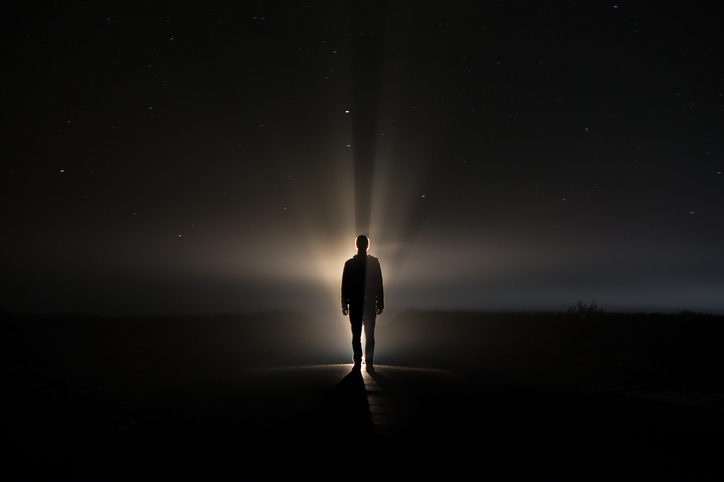 During a surgical procedure, Jaime's endotracheal tube—which facilitates life-preserving respiration while under anesthesia—malfunctioned, causing his heart to convert to an abnormal rhythm that cannot sustain life. He found himself floating in darkness, eventually discovering it to be a tunnel lined with doors on both sides. Jaime was being pulled towards a point at the "end" of the tunnel, a magnificent light source that grew in size as he floated closer to it. Suddenly finding himself inside the light, Jaime was overwhelmed with a sense of euphoria that was "like the best drug." He was met there by his grandmother, who had died of dementia. She stood a radiant figure, appearing as Jaime remembered her when in her thirties, donning a purple dress that was spotted with fluorescent yellow flowers. Jaime sat with his grandmother at a table. They had a brief conversation and even drank "coffee." Finally, she told him to tell their family that she loves them very much, but that he had to go back, that this was not his time. The doctors and nurses successfully resuscitated him, and much to his chagrin, Jaime found himself immediately back inside his body, painfully still attached to machines by the standard tubes and intravenous lines (IVs) with his (living) family standing over him.1 People that experience traumatic events that bring them to the brink of death, or actually leave them clinically dead like Jaime—for a brief period of time—commonly report having such near-death experiences (NDE). No two NDEs are the same, but there are some features that tend to recur. Experiencers will report tunnels of light; being inundated with an incomprehensible sense of peace; and often will meet with departed loved ones, beings of light, or religious icons. While there are exceptions, most that experience NDEs report them to be dramatically positive experiences. On a seemingly-ordinary September evening in 1966 near Greensboro, North Carolina, David and two of his friends were driving through the countryside, trying to kill time while awaiting a local nightclub to open. For reasons that forever remained unclear, the driver exited onto a side road and brought the car to a halt. The three boys then saw a large, mysterious orange light hovering above the tree line. They were transfixed by the spectacle, wanting to talk to one another but somehow unable to do so. The next thing David remembered was driving back to the club with his friends and walking inside. The clock on the wall indicated that two hours had passed, for which they were unable to account. Eventually, David submitted to hypnotic regression and was taken subconsciously back to the moment when he and his friends saw the strange light. Investigator Budd Hopkins, who was present during the regression, commented that the sense of horror and trauma that David exhibited as he recounted the forgotten experience was unlike anything he had ever witnessed. Unable to move, David saw figures emanating from the light that took him from the car and into this light—apparently a craft of some kind—where he was involuntarily restrained and subjected to an invasive examination. The obvious discomfort that David demonstrated while reliving this harrowing process betrayed the excruciatingly-painful nature of the experience. Finally, David was taken back to the car where his friends still sat, evidently in suspended animation.2 Alien abductions could not seem to be more different than NDEs. Instead of tunnels of light, abductees report being involuntarily raised into a space craft or taken into an underground chamber or matrix-like reality. Instead of meeting angels or departed loved ones, abductees' captors are frequently frightening (e.g., the grays, who are four feet tall, with thin, horizontal slits for mouths, vestigial-to-nonexistent noses and ears, and black wraparound eyes). As with David, frequently the abductee is placed on a table and made to undergo horrifying procedures at the hands of their emotionally-indifferent abductors. Often these frightful experiences will recur multiple times in the abductee's life. The aftermath of these harrowing experiences is commonly marked by nightmares and other post-traumatic stress disorder (PTSD) symptoms, and a dreadful anticipation of future abductions. Abductees' houses are often left haunted, plaguing them with poltergeist and other disturbing paranormal phenomena. And if they are really unlucky, they may be visited by sinister Men-in-Black who intimidate them into staying silent about their experiences. Nevertheless, when we dig beyond the surface, there is an unexpected and mysterious correlation in the aftereffects of those that experience NDEs and those that experience alien abduction.
For more information supporting the items in the above list, the reader is strongly encouraged to consult the sources listed below.6 Conclusion Transformed by these ineffable encounters, experiencers return with a newfound sense of purpose. Equipped with new interests and abilities, they shun former self-destructive behaviors and are more altruistic. No less intriguingly, they often find themselves to be more sensitive to dimensions of reality that are imperceptible to most of us. This convergence of aftereffects common to experiencers of NDEs and alien abduction is unlikely to be coincidental. In The Metaphysics of UFOs, I argue that there is more to the abduction phenomenon than meets the eye. These are more than just encounters with technologically-sophisticated extraterrestrials, as remarkable as that alone would be. No, the phenomenon hints at something more, something much deeper than that. In my estimation, experiencers meet with intelligences that operate from beyond the limits of our ordinary three-dimensional reality. Against such a backdrop, it is my contention that the spacecraft are stages, the abductors are actors, while the examination table and the surgical tools are merely props. They all serve as part of a theatrical performance laden with symbolism whose purpose is to awaken obscure, latent abilities in the experiencer and, more importantly, calibrate their moral compass. If this is correct, the transformation is not a mere side effect. It is precisely the point. Encounters with these other realms are meant to change us. "What are UFOs?" and, "Are we alone in the universe?" are important questions. The most unsettling question of all, however, may be, "What do they want us to become?" Bibliography |
Jonathan Kendall is a board-certified medical doctor in internal medicine and nephrology. As a physician, he is in a relatively unique position to evaluate potential medical and psychological explanations for paranormal ...