
Llewellyn Worldwide, Ltd.
My Account | Help | View your shopping cart Shopping Cart We accept VISA, MasterCard, American Express
Browse ProductsAuthorsArticlesBlogsEncyclopediaNewslettersAffiliate ProgramContact UsBooksellers
Advanced Search
LLEWELLYN JOURNAL
Article Topics
List of Articles
RSS Data Feeds
Mission Statement
Use of Our Articles
Writers' Guidelines

Email Exclusives
Sign up to receive special offers and promotions from Llewellyn.

Get the Latest Issue of New Worlds

March / April 2010 Issue

New Worlds Catalog

Download the PDF File version of the latest issue of Llewellyn's New Worlds Catalog


The Llewellyn Journal
Print this Article Print this Article

Thoughts about Ritual

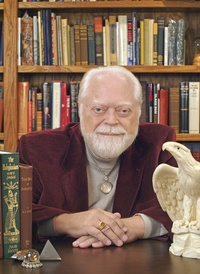
This article was written by Carl Llewellyn Weschcke
posted under Magic & Ritual

This is an article from Carl's previous blog, Conversations Across the Table, originally posted on Friday, March 25, 2005

First, let me apologize for not writing recently. It’s been a very busy time and I have had such minor matters as a tooth extracted, getting my income tax stuff together, selling a few rare Crowley books I had collected and now have in modern editions for reference, on-going remodeling projects at home, and visits to our new grand daughter. And we’ve had lots of business meetings in relation to our new headquarters building now under construction.

But, you know, I truly have a hunger for writing! It’s like wanting a snack in between meals or at night before bed. Writing, like good conversation, stimulates thinking and organizes thoughts. Sometimes you can be amazed at what you didn’t know you knew! Or that you discover in the process. It’s like an experiment where you assemble ingredients, boil them together, and then make a new discovery.

Not long ago, in a “conversation across the table,” my wife asked if I was only going to write about things remembered, or would I write about current events or my own ideas about subjects of interest.

It was always my expectation to move from past to present to future, but perhaps I should break it up. I have memory/notes about my personal past involvements in this whole area of “occultism” (New Age, Metaphysics, Spirituality, Wicca, etc.), but I am more of an analytical thinker and a “futurist.” Over the years, I’ve been active in businesses other than publishing – including real estate, manufacturing, retailing, and wholesaling – and I’ve done some teaching, lecturing, appeared on television and radio shows, did radio commercials, wrote advertising copy, acted in a movie, worked in civil rights and civil liberties causes, and I used to go fishing, gardening, played hockey, worked with politicians, re-modeled several houses, traveled with my family, and read a lot of books.

But what I have done mostly for the last 45 years is publish and sell books. And that’s what I love most. Still, I thought publishing would allow me to write more myself than I have. I have written advertising and editorial copy for our publications and in “Gnostica” magazine we used to publish, but I’ve yet to write a book (other than one I did about 55 years ago and self-published titled The Science of Feeling Fine. It’s not available.).

But, in truth, I think a lot. Our staff and family fear what ideas I will throw out next when we haven’t finished with the last batch. Not all ideas are practical or useful. Many are “just ideas” and speculations: Ideas for new books, for peace and harmony, about global issues, and concerns about things in the news. The Mind is a wonderful thing.

It so happened that when she asked the question I was thinking about Rituals. Not the rituals we’ve undertaken – although some of those were very interesting with interesting results, and might be worth writing about one of these days – but rituals in general.

What is a Ritual?

I am sure that every magician and ceremonialist will have a different definition, but here’s mine:

A ritual is an organized procedure intended to accomplish a goal. Although organized it can be either planned or spontaneous. The key factor is intention. A well planned ritual can be likened to a “craft.”

Obviously this broadens our concept of ritual beyond the familiar association with religion and magick. In this broad sense we do rituals all the time – from the morning rituals of shaving & “putting on a face” to dressing, preparing a meal and on to our daily tasks. All, or at least most of these activities are intentional – some minimal, such as “just pulling on a pair of jeans to cover ‘the bode,’” while others are carefully crafted to create a particular effect in association with a major event.

Aside from these personal “rituals,” we have many others – from the world of diplomacy to that of business, justice, and every profession ever invented by mankind. But let’s go back to those rituals of religion and magick.

Kinds of Ritual

1. Ritual performed by one or a few persons before an audience. Sometimes these rituals are for the benefit of the audience, other times for the benefit of a targeted person, persons, or project.

2. Ritual performed by a group to benefit a target person or project.

3. Ritual performed by a group for mutual support or a common project.

4. Ritual performed by two people interacting, as in sex magick or Tantra.

5. Ritual performed by one person for the benefit of another person.

6. Solitary rituals as in spell-casting or personal project.

I probably haven’t defined every ritual type there is, and you can argue to the contrary that I’ve already come up with too many variations of the basic formula: action intended to accomplish a specific goal.

Can we learn from crafting a magical ritual to the better crafting of our mundane and everyday rituals?

Yes, of course we can. Whether it is merely showing up for work, following instructions, and getting a paycheck, or planning and executing a detailed plan to substantially increase sales or to cut costs, the concept of “action intended to accomplish a goal” is the necessary structure of a ritual. The beginning and the end.

But, what about “organized procedure?” There is where we get all the differences we see in familiar religious and magickal rituals, and in those associated with dinner speeches, graduation ceremonies, court matters, legislative actions, etc.

Awareness

But, wait! Before we tackle what I mean about “organized procedure” and what goes into that, we must by now see the difference between those familiar and mundane rituals like shaving in the morning and which too often become rote and habit and those that require awareness and concentration.

Think about driving the familiar route to work. Awareness and concentration are vital in most commutes today. Without them, you probably end up in a hospital ward talking with a policeman or a lawyer.

And, aside from “just pulling on a pair of jeans,” most of us give special attention to our clothing in relation to what we will be doing that day or occasion. Do we need to be formal? Or wear protective clothing? Are we thinking of romantic, or sexual, encounters? Do we need to make a particular kind of impression as when interviewing for a job? Or are we dressing for a brisk run in the park?

Yes, part of this relates to our goal in performing the ritual – which might be getting a particular job – but awareness involves perceptions about the environment surrounding the whole operation. The magician might include awareness of astrological conditions, perception of non-physical forces and entities, temperature, the place of the operation, etc.

Working with awareness is a vital part of every successful ritual.

Organization

If we want to get from one place to another, we generally have to gather and organize equipment, materials, and energies. The same is true if we want to move from one “state of consciousness” to another.

For some magicians, this means the inclusion of special robes, the assembly of materials and symbols based on magical correspondences that help focus consciousness and the evoked energies, planning the choreography of stationary postures, movement and gestures, along with speeches, prayers, recitations, mental imagery, lots of incense and oils, perhaps recorded music, etc.

For others, simplicity and restraint work better. And the more experience you have the less dependent you become on the externals. Too much clutter, too many people, too much recitation, and sometimes too much incense and mind-altering substances – all can get in the way of an effective and efficient ritual, magical or otherwise.

Energy and Focus

What is all the clutter for?

The purpose of all the accessories is too help you focus on both the procedure and the energies either invoked (from inside) or evoked (from outside). And, of course, gathering them, or making them, can be enjoyable and ritualistic as well.

Let’s drop back into the mundane world for a moment. There is really little difference in the ritual formula between the magico/religious world and the mundane/practical world applications.

What is different is found in the materials and energies. Driving to work you choose a car, give it fuel (energy), put it into motion, follow a map (usually in your mind), arrive at your destination (the established goal), park your car, and get out. All the steps of a magical or religious ritual are set forth in this simple, everyday world, example.

You can drive an inexpensive Chevrolet, an expensive Cadillac, or a jazzy Corvette – but it’s still a vehicle to go from one place to the next. You can fuel your car with high octane gasoline – perhaps mixed with methanol, diesel fuel, electricity, or - soon – with hydrogen. You can map your route with a GPS system or a paper map. You can have radio on, or play music from the CD player. And so on. You can even sing, talk to yourself, go over the day’s work in your mind, or plan the next ‘big thing.’ You park the car in a lot or garage, lock it, and walk to your destination. You’ve opened a ritual, and you’ve closed it.

You can make it simple and efficient or complex and perhaps less efficient. And the more complex, the greater the reliance on external factors – a Cadillac costs more than a Chevrolet, so you have spent more resources than necessary and may still be paying for the car which is a fact that slips into your awareness and dissipates your focus.

With rare exception, I have found the same rule in the magical and religious worlds. The more people, the more the materials and accessories, the less the focus. There may be a lot of energy flying around, and people get high on that and speak of the wonder and glory of it all – but the most effective and powerful rituals I’ve done have been private and internal. Purely mental. The Mind organizes memories, arouses and focuses energies, visualizes a goal, and accomplishes results.

Solitary may be less fun – especially in relation to ritual celebrations and dramatizations – but it gets the job done.

What do you think?


RELATED PRODUCTS

The Elements of Ritual
Air, Fire, Water & Earth in the Wiccan Circle
Deborah Lipp
$19.95 $13.97 On Sale! | Add to Cart
Ritual Magic
Ritual Magic
What It Is & How To Do It
Donald Tyson
$12.95 | Add to Cart
RitualCraft
RitualCraft
Creating Rites for Transformation and Celebration
Azrael Arynn K, Amber K
$24.95 | Add to Cart

Please note that the use of Llewellyn Journal articles
is subject to certain Terms and Conditions

Curiosity is a great cure-all because it generates energy and enthusiasm. Even if you don’t have much control over your present circumstances, you can nevertheless indulge your curiosity with simple tarot readings. The following is a “card search” technique that gives you something to look forward to. As you shuffle your deck,... read this article
The Astrological Elements: How Compatible Are Your Sun Signs?
The Everyday Clairvoyant: What’s Your Gift? (And Does It Help You Clean The House?)
Court Cards, Part I: The Kings of Tarot
Court Cards, Part II: The Queens of Tarot
Court Cards, Part III: The Knights of Tarot

Most recent posts:
Sun Enters Aries
Aries, The Ram March 20 to April 19 Modality: Cardinal Element: fire Ruler: Mars Keywords: Initiative, action, adventurous, enthusiastic,...

Tomorrow is International Astrology Day!
Tomorrow is International Astrology Day! Considered by many to be the start of the astrological new year, International Astrology Day is...

Potatoes and Competition
There is a famous song by George and Ira Gershwin called "Let's Call the Whole Thing Off" which they wrote for the 1937 movie, Shall We Dance? It was...


Some of you may be familiar with the name "Oliver Haddo." It's the name Aleister Crowley used (he used lots of pseudonyms) when he wrote a few...


Llewellyn's 2010 Astrological Calendar Llewellyn's 2010 Astrological Calendar
By: Llewellyn
Price: $13.99 $7.00 On Sale!
Llewellyn's 2010 Witches' Datebook Llewellyn's 2010 Witches' Datebook
By: Llewellyn
Price: $10.99 $5.50 On Sale!
Llewellyn's 2010 Witches' Calendar Llewellyn's 2010 Witches' Calendar
By: Llewellyn
Price: $13.99 $7.00 On Sale!
Llewellyn's 2010 Magical Almanac Llewellyn's 2010 Magical Almanac
By: Llewellyn
Price: $10.99 $5.50 On Sale!
Llewellyn's 2010 Moon Sign Book Llewellyn's 2010 Moon Sign Book
Plan Your Life by the Cycles of the Moon

By: Llewellyn
Price: $10.99 $5.50 On Sale!